We live in a deeply globalised era where distant nations influence one another through trade, finance, and culture, often without formal political control. The United States, China, and other powers project authority far beyond their borders. This phenomenon has deep historical roots, most clearly visible in 19th-century Britain’s “informal empire.”
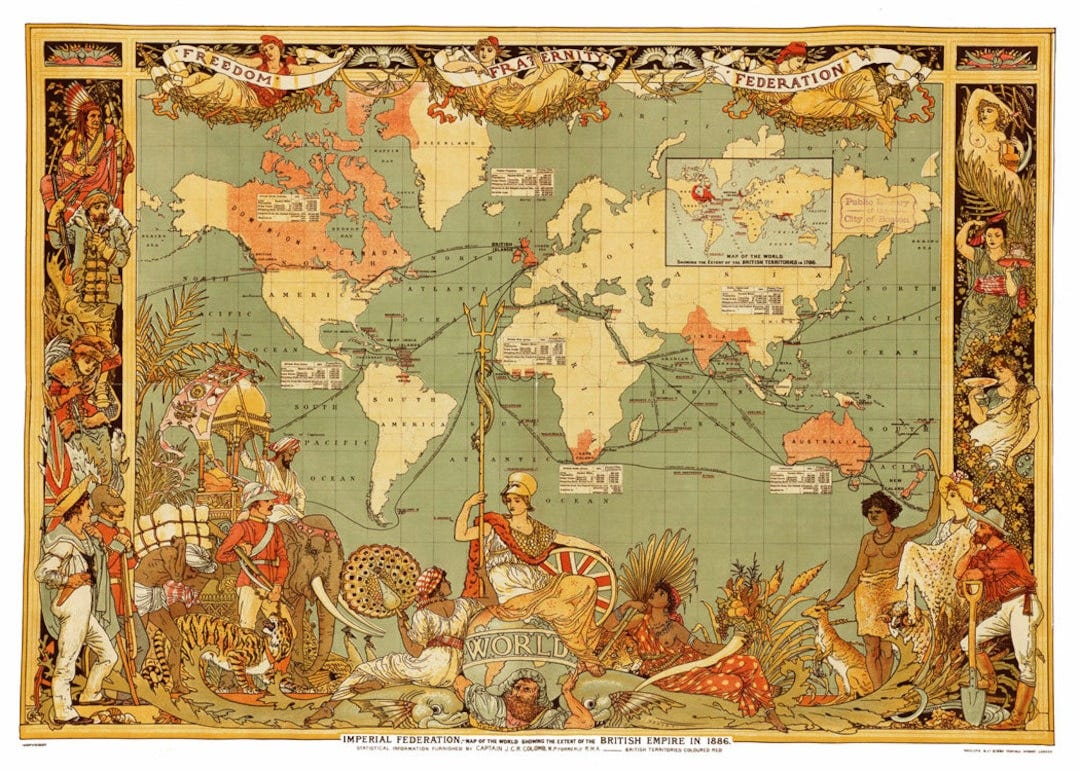
Coined by historians Ronald Robinson and John Gallagher in their influential 1953 article “The Imperialism of Free Trade,” the term describes how Britain extended its economic, political, and cultural dominance without always planting flags or establishing direct colonial rule. Britain’s elites which consisted of merchants, bankers, politicians, and entrepreneurs helped to develop a capitalist globalisation project that restructured societies worldwide. As historian Gregory A. Barton notes, this “westernisation” exported selective elements of European society: rule of law, democratic capitalism, industrialisation, free trade, consumerism, and bureaucratic governance. These forces transformed both European and Global South cultures, for better and worse, while sparking resistance.
Gallagher and Robinson argued that focusing only on the formal British Empire (coloured red on maps) misses the full scope of British power. After the Napoleonic Wars ended in 1815, Britain “won the peace.” Its Industrial Revolution-generated goods flooded global markets, backed by the Royal Navy’s unchallenged supremacy — what contemporaries called Pax Britannica. The navy suppressed the slave trade, charted distant seas, opened routes for commerce, and subdued coastal groups that threatened trade. Britain resorted to formal annexation reluctantly, usually when informal influence faltered under international pressure (as in the 1870s “Scramble for Africa”).
Barton outlines five stages of informal empire:
- Initial fear of domination or an invitation for trade/protection
- Collaboration (with or without force) and new exchange conditions
- Elite-led governmental adaptation toward Western models
- Consolidation of elite power via economic and administrative gains
- Graduation into a broader imperial network of elites
Free trade was the central tool. By the 1840s, Britain unilaterally dismantled tariffs, inspired by Adam Smith and the Manchester School’s vision of peace through commerce. As Sir John Bowring famously declared, “Jesus Christ is free trade, and free trade is Jesus Christ.”
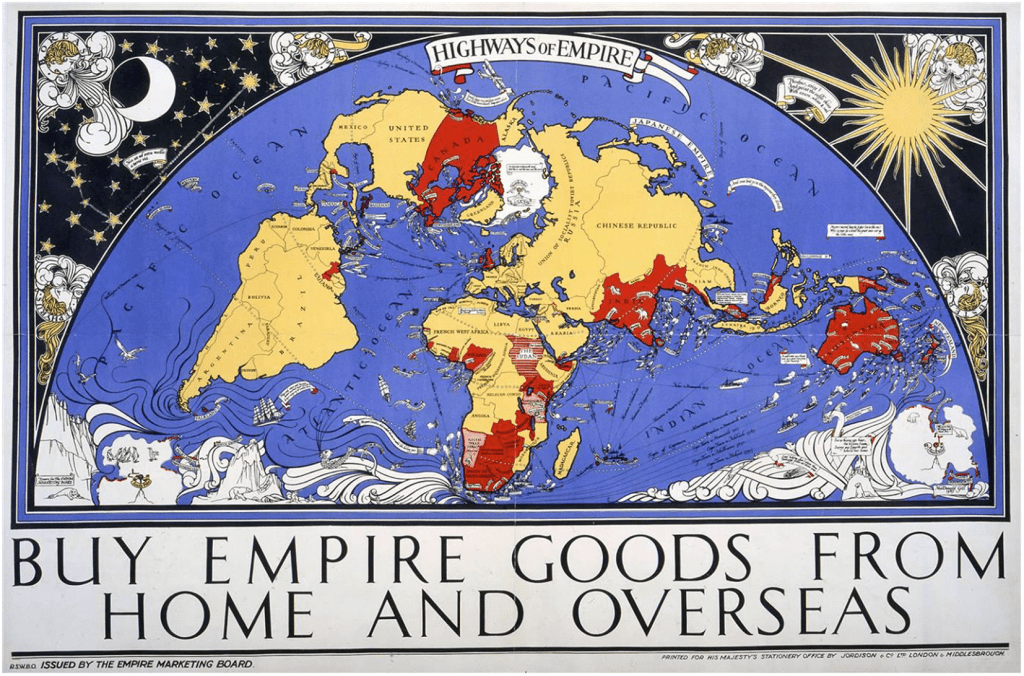
Latin America: The “British Century”
The Latin American independence wars (1810–1824) dismantled Spain’s empire and created openings for Britain. Illicit trade had already flourished; now legitimate commerce exploded. Thousands of Britons, ranging from soldiers and engineers to merchants and diplomats flooded the region. By 1913, Latin America absorbed over £999 million in British investment — more than a quarter of Britain’s total overseas capital.
Foreign Secretary George Canning remarked in 1824: “Spanish America is free, and if we do not mismanage our affairs sadly, she is English.” Paradoxically, informal empire required local sovereignty. Independence enabled British influence while preserving the façade of freedom.
Uruguay offers a striking case. During the Cisplatine War (1825–1828), Montevideo elites begged Britain to annex them for stability and trade. London declined, preferring influence without responsibility. British merchants and investors later turned Uruguay into an entrepôt. By the 1860s–1880s, loans, railways, cable connections, sheep farming, and meat processing tied the economy to Europe. Investment peaked at over £40 million by 1900 which was enormous relative to Uruguay’s size. Yet strategic decisions remained in London, rendering political independence hollow for many Uruguayans.
Argentina followed a similar trajectory. The 1825 Anglo-Argentine Treaty established free-market ties. The 1824 Baring Loan funded early independence governments, though defaults followed. After 1870, British capital surged into railways, enabling Argentina’s transformation into a major wheat and beef exporter. British firms dominated the network (reaching over 32,000 km by 1890), yet the Argentine state intervened when necessary, showing the limits of pure dependency. Critics decried foreign penetration, but integration into global markets brought customs revenue and growth — albeit on Britain’s terms.
China and Siam: Asian Variations
In Asia, Britain held formal colonies (India, Ceylon, Burma) but relied on informal methods elsewhere. China experienced gunboat diplomacy (Opium Wars), unequal treaties, and extraterritoriality, opening ports and granting concessions to British merchants and banks. Capitalist agents reshaped coastal economies, while local elites adapted — or resisted.
Siam (Thailand) presents a subtler case. King Mongkut signed the 1855 Bowring Treaty, granting British extraterritorial privileges. His successor, Chulalongkorn, navigated French and British pressure by leaning toward the “whale” (Britain) rather than the “crocodile” (France). Siam remained nominally independent but became economically tethered: British firms dominated teak extraction (via companies like the Bombay Burma Trading Corporation), shipping, and finance. British advisors influenced ministries, and Bangkok used economic ties to centralise power over peripheral regions: an “internal colonisation” facilitated by British capital and strategic backing.
The “gentlemanly capitalists” thesis — aristocrats, financiers, and politicians shaping policy — helps explain this pattern. Influence flowed through personal networks, lobbying, and economic leverage rather than overt conquest.
Legacy and Relevance Today
Britain’s informal empire integrated peripheral economies into an industrial core on unequal terms. Local elites often collaborated, gaining wealth and status while sacrificing autonomy. Resistance, from Rosas in Argentina to anti-foreign movements in China helped to highlight the tensions.
This model prefigured modern globalisation: powerful states and corporations exert influence through investment, trade agreements, debt, and cultural soft power, rarely needing formal rule. The consequences, ranging from transformed societies, rising living standards alongside inequality and cultural disruption still helped to define our world.
Understanding informal empire reveals how power operates in the shadows, beyond maps and flags. It reminds us that globalisation has never been neutral; it has always been shaped by those who control capital and commerce.
Sami Pinarbasi – Manchester
 Sami Pinarbasi
Leave a comment